


A nationwide register of entrepreneurs and digital business administration system
For the Ministry of Economy, we designed, developed, implemented and maintained the teleinformation system of the Central Registration and Information on Business — CEIDG.
The system was created to centralize the processing of data on entrepreneurs who are natural persons, provide access to information on business activity, and digitalize the processes of registering, updating, suspending and resuming business activity.
CEIDG enabled entrepreneurs to handle key matters related to their business without having to visit multiple public offices in person. Thanks to integration with public administration systems, a single application submitted in CEIDG could trigger the flow of information to several institutions, including the tax office, ZUS, GUS and other state registers.
The project was implemented in 2010–2014, and the system was subsequently maintained and developed in 2015–2021.
Challenge
Before CEIDG was implemented, data on entrepreneurs was distributed across municipal registers, and many procedures required personal visits to public offices. Registering a business, changing company data, suspending or resuming business activity involved administrative procedures carried out in multiple places.
The objective of the project was to build a central system that would enable:
- registration of entrepreneurs who are natural persons,
- free access to public data on entrepreneurs,
- electronic submission of applications,
- handling of electronic signatures, including through ePUAP,
- import of data from municipal registers,
- normalization of imported data,
- integration with key public administration systems,
- access to publicly available data from the National Court Register.
Another major challenge was the scale of the system. From the beginning, CEIDG was intended to handle nationwide administrative processes, large data volumes and periodic load peaks caused, among other things, by changes in legislation and increased numbers of submitted applications.
Context and limitations
The project required integration with many state systems, including ePUAP, GUS, ZUS, KRUS, KRK, PESEL and other public registers and services.
One of the important limitations was the initial readiness of some institutions for full system integration. In many cases, before these institutions implemented their own systems capable of API-based communication, it was necessary to prepare modules enabling them to process applications directly within CEIDG.
Over time, as public administration digitalization progressed, integrations were expanded and more institutions were able to communicate with the system in a more automated way.
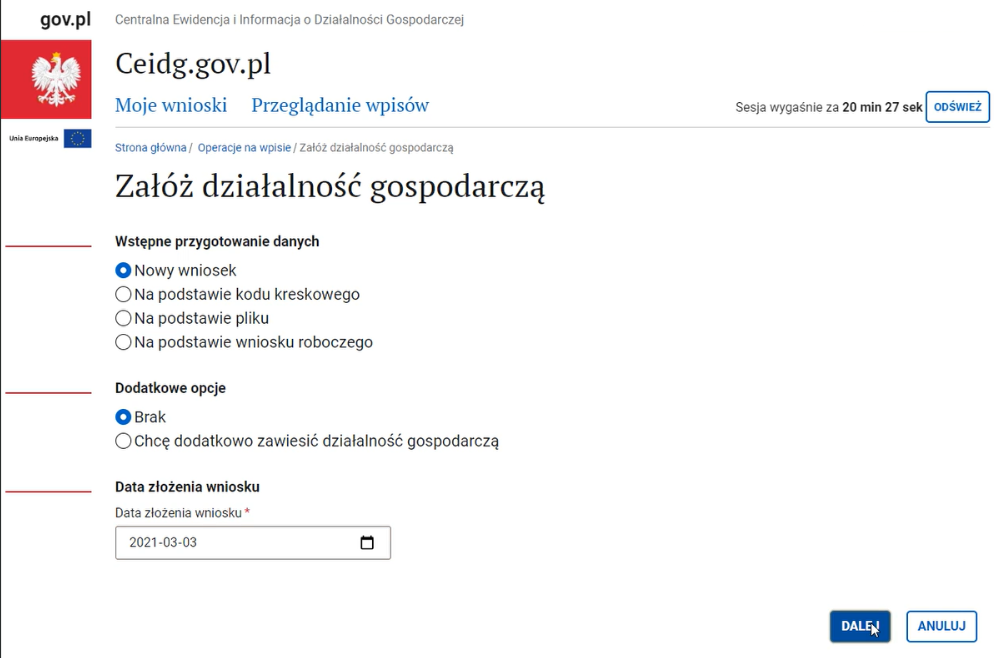
In 2020, the system underwent a significant visual transformation — the entire interface was adapted to the GOV standard, which required redesigning the presentation layer and adjusting the user experience to current public e-service standards.
Scope of work
As part of the project, we were responsible for the design, implementation, deployment and maintenance of the CEIDG system.
The scope included, among others:
- analysis of business requirements and administrative processes,
- system architecture design,
- development of modules supporting registration and data modification processes,
- handling of electronic applications and documents,
- integration with ePUAP and other external systems,
- import and normalization of data from municipal registers,
- handling of electronic signatures,
- development of reporting and administration tools,
- system maintenance and support for further development.
Our solution
We built a central teleinformation system supporting processes related to the business activity of natural persons. The system enables entrepreneurs to submit electronic applications and allows public administration to process data, handle changes and exchange information between institutions.
The key elements of the solution included several system modules.
ESP — Electronic Submission Box
The ESP module provides Electronic Submission Box functions for processing system workflows. Its main task is to verify incoming documents for the correctness of electronic signatures and issue Official Confirmation of Receipt.
This enabled secure receipt of electronic documents and formal handling of correspondence as part of administrative procedures.
External systems communication module
The communication module provides interfaces for exchanging data with external systems involved in the implemented processes.
The system was integrated with, among others:
- ePUAP,
- GUS,
- ZUS,
- KRUS,
- KRK,
- CRPKEP,
- PESEL,
- National Node,
- banking systems,
- biznes.gov.pl,
- notarial systems.
These integrations enabled the automation of information flow between entrepreneurs, CEIDG and public institutions.
Registration and data modification process module
This module is responsible for the business logic of managing CEIDG entries. It handles processes related to registration, data changes, suspension, resumption and other operations concerning business activity.
As a result, an entrepreneur can submit a single application, while the system automatically forwards the relevant data to the appropriate institutions.
Reporting module
The reporting module provides advanced reports on system usage and the status of the CEIDG system. It supports operational data analysis and monitoring of the platform’s performance.
Signature preservation module
The signature preservation module handles electronic signatures and their preservation, ensuring the continued validity of signatures on historical electronic documents.
This was particularly important in a public administration system where electronic documents must retain their evidential and formal value over the long term.
Technologies
The project used, among others:
- Microsoft SQL Server,
- C#,
- ASP.NET,
- Apache ODE,
- WS-Security.
The technology stack was selected to meet requirements related to security, integration, administrative process handling and the scale of a nationwide public system.
Results
The implementation of CEIDG enabled the digitalization of one of the key administrative processes related to running a business in Poland.
Instead of visiting the municipal office, tax office, ZUS and statistical office separately, an entrepreneur could submit a single application in the system. CEIDG automatically forwarded data to the relevant institutions, improving the flow of information and reducing the need to provide the same data multiple times.
The system also enabled free access to public information on entrepreneurs and free handling of registrations and changes in the register. Before the system was implemented, many municipalities charged administrative fees for entries in local registers.
After the implementation of CEIDG, operations such as changing a company address, extending PKD business activity codes, suspending or resuming business activity could be carried out electronically. This was particularly important for entrepreneurs running seasonal businesses, for whom quick suspension and resumption of activity can be essential.
System scale
CEIDG is a system operating at a very large scale in terms of data processing and user handling. According to the provided data, the system included:
- over 6 million registered entrepreneur entries,
- over 18.6 thousand registered official accounts,
- over 21.4 million processed applications in 2011–2022,
- over 448 thousand permit and license entries,
- over 445 thousand proxy entries,
- approximately 700 thousand downloaded certificates per month,
- approximately 1 thousand logged-in users working simultaneously between 8:00 and 16:00,
- over 5 thousand anonymous users working simultaneously,
- over 2.4 TB of transactional database volume,
- approximately 8.7 million searched entries per month.
Such a large operating scale required a dedicated approach to performance, availability, monitoring, reporting and integration with external systems.
Project organization
The project was managed in accordance with the PRINCE2 methodology, which provided structured management of scope, risks, implementation stages and stakeholder communication.
The project team included:
- project manager,
- chief architect,
- business analysts,
- developers,
- testers,
- administrators,
- technical supervision specialists.
This team structure made it possible to combine administrative, analytical, development, integration and infrastructure competencies necessary to deliver a nationwide public administration system.
Summary
CEIDG is one of the key digital public administration systems in Poland. Its implementation enabled the centralization of entrepreneur data, digitalization of the business registration process and integration of information flows between many state institutions.
The system allowed entrepreneurs to handle matters related to business activity electronically, without having to visit multiple public offices in person. For public administration, it provided a consistent environment for handling entries, changes, electronic documents, reporting and data exchange.
The project required combining expertise in system architecture, integration with state registers, electronic service security, electronic signature handling, performance and long-term maintenance of a nationwide system.