


Digitalization of the non-preferential certificates of origin process
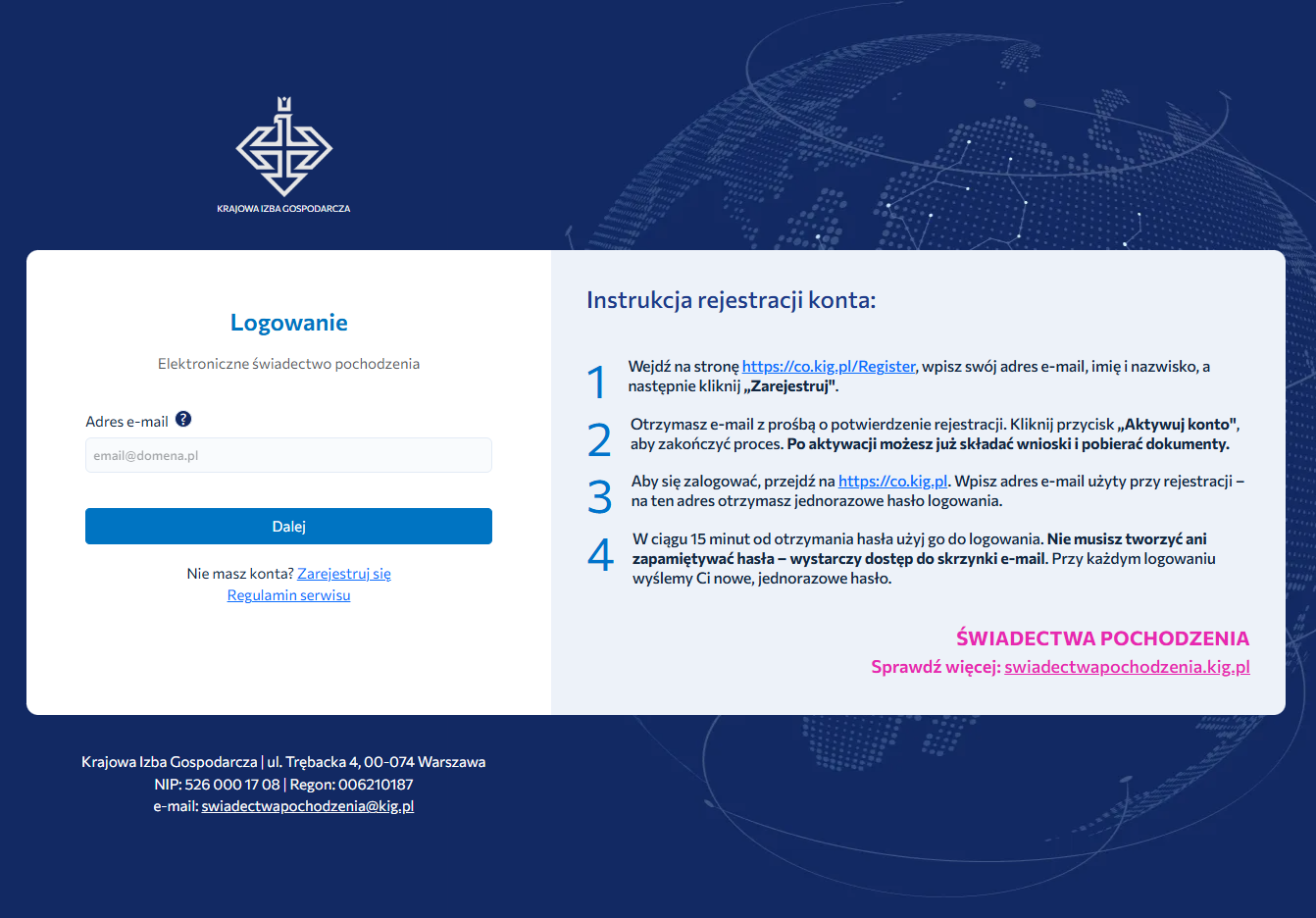
For the Polish Chamber of Commerce, we are building, developing and maintaining KIG eCO — a platform supporting the electronic handling of non-preferential certificates of origin for goods.
The system was designed to digitalize a process that, in its traditional paper-based form, was time-consuming both for exporters and for the teams responsible for processing and verifying documents. The solution enables users to submit applications online, supports backoffice processing and allows verification of the authenticity of issued certificates.
The project has been carried out since 2024 and includes ongoing development and system maintenance.
Challenge
The traditional process of issuing certificates of origin was labor-intensive and inconvenient for exporters. It required users to complete formal activities that extended the time needed to obtain a document and limited the flexibility of the process.
Another important issue was the verification of the authenticity of paper certificates. Confirming whether a document was original involved significant time costs, especially in the case of verification requests from foreign entities.
An additional challenge was the high complexity of the certificate application itself. The system had to provide a highly ergonomic user experience, guide users through the process clearly and reduce the risk of errors. It was also important to create a registration and authentication process for new users that would be as self-service as possible.
Scope of work
As part of the project, we participate in business analysis and UI/UX design, develop the system architecture, implement new functionality, and provide ongoing development and maintenance.
The functional scope includes:
- a certificate application module,
- backoffice support for certificate processing,
- a certificate verification module,
- user registration and authentication,
- integrations with external services,
- payment handling,
- ongoing system development and maintenance.
The system supports applicants, backoffice staff responsible for processing applications, and entities verifying the authenticity of issued certificates.
Our solution
We designed and continue to develop a platform enabling comprehensive electronic handling of certificates of origin — from submitting an application, through backoffice processing, to subsequent verification of document authenticity.
Particular emphasis was placed on the ergonomics of the application form. Due to the complexity of the data required to issue a certificate, the interface had to guide users through the process in a clear and intuitive way. The goal was to reduce the number of errors, speed up application submission and minimize the need for additional contact with support staff.
In the backoffice area, the system supports application processing, verification and handling of subsequent process stages. The platform also includes a certificate verification module, allowing authorized or interested entities to confirm the authenticity of issued documents.
As part of the project, we implemented integrations with:
- GUS REGON — to support company identification and data completion,
- International Chamber of Commerce API — to support processes related to certificate handling and verification,
- PayU — to handle payments for certificate issuance.
Technologies
The system was developed using:
- Python,
- React,
- PostgreSQL.
This technology stack enabled the creation of a modern web application that supports further development, integration with external services and online process handling.
Results
The implementation of KIG eCO simplified and significantly improved the flow of certificate of origin applications. The system moved the process to a digital channel, allowing users to submit applications 24/7/365, without being limited to office working hours.
One of the key results was reducing the average application processing time from approximately 2 business days to around 1 hour. The solution also helped strengthen the payment process thanks to integration with electronic payments.
During the first year of operation, the system recorded:
- approximately 1,800 processed applications,
- approximately 1,000 system users,
- reduction of average processing time from around 2 business days to approximately 1 hour,
- verification requests from 22 countries,
- approximately 3,000 verification requests.
Project organization
The project was carried out using an agile methodology, enabling ongoing clarification of requirements, iterative development of functionality and regular verification of results.
The project team included:
- a business analyst,
- a UI/UX designer,
- an architect,
- a developer,
- a tester.
This team composition allowed us to combine business, design and technical perspectives — from process analysis and interface design to implementation, testing and maintenance.
Summary
KIG eCO supports the digitalization of the process of issuing non-preferential certificates of origin for goods. The solution made it possible to move a labor-intensive paper-based process to an electronic channel, improve application handling, shorten processing time and enable convenient verification of certificate authenticity.
Thanks to integrations with GUS REGON, the International Chamber of Commerce API and PayU, the system supports automation of selected process stages, improves user experience and increases control over payments.
The project is continuously developed and maintained, providing the Polish Chamber of Commerce with a stable e-services tool for exporters.
Read more at the Polish Chamber of Commerce website.