


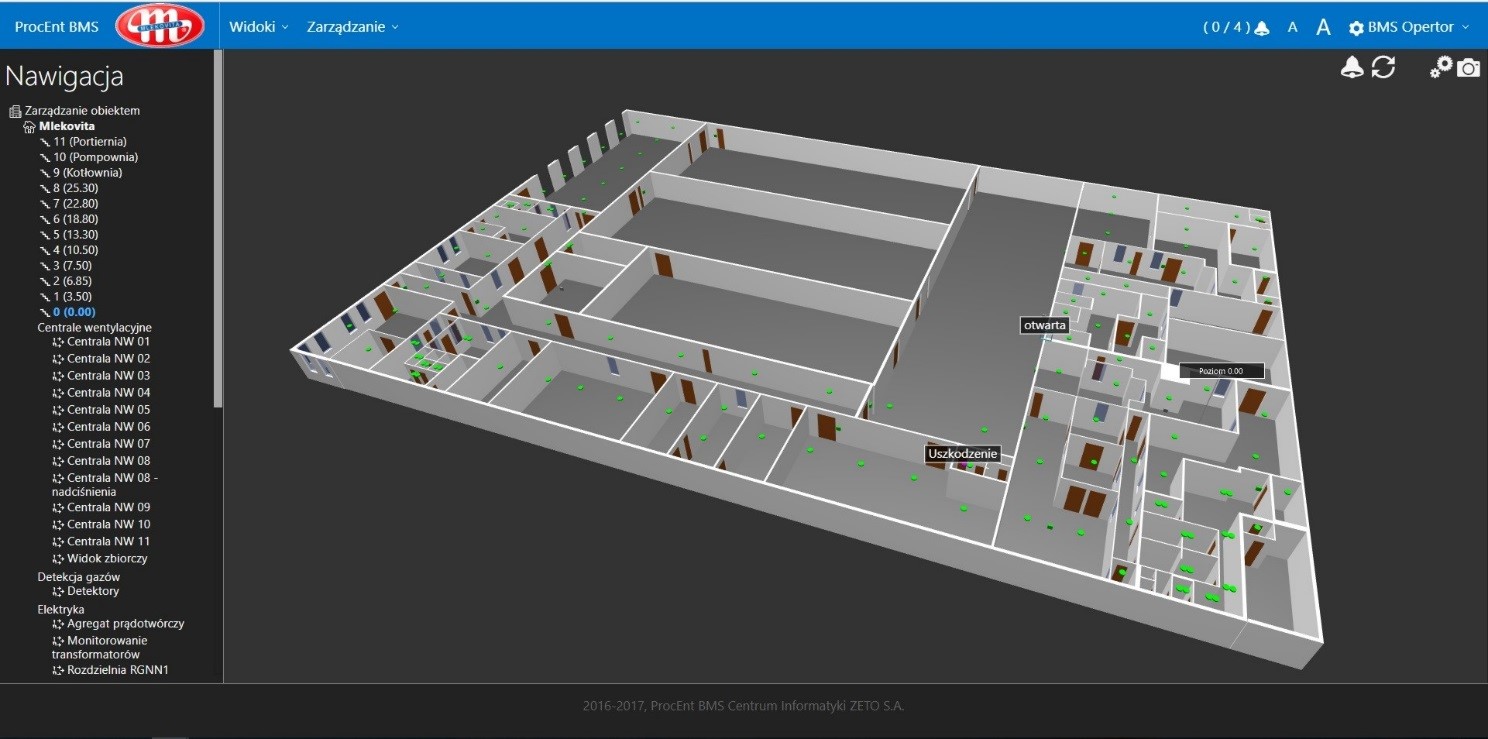
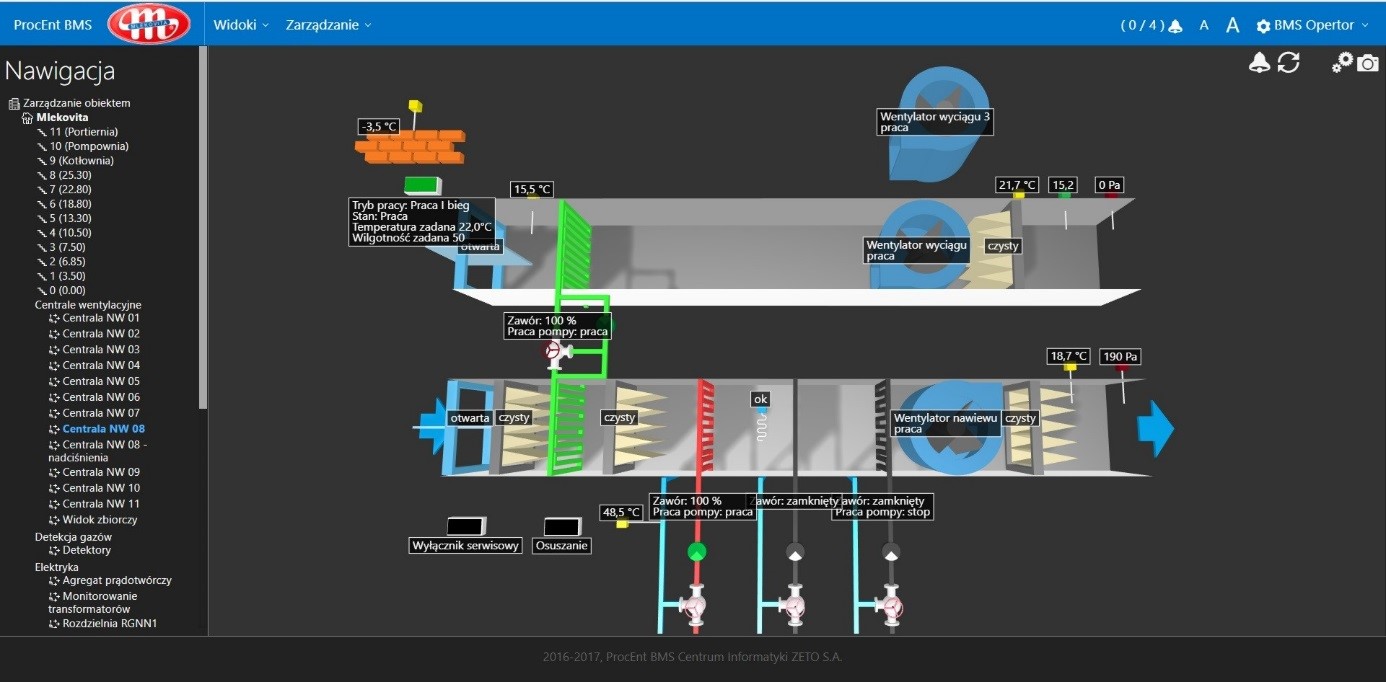
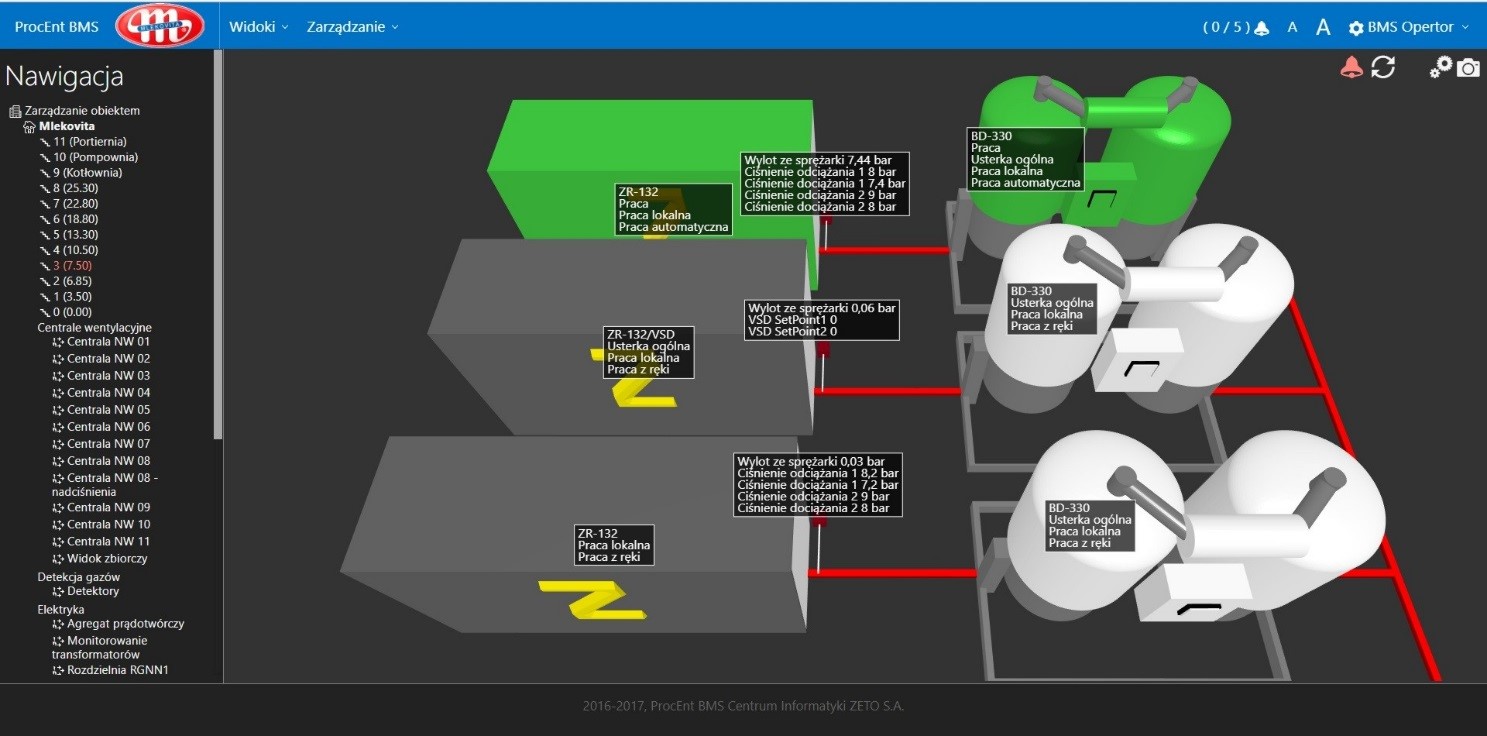
The system supports 1,139 devices and 43 installation views, enabling operators to quickly access information about the status of monitored infrastructure elements.
Our Solution
We designed, implemented and deployed a system consisting of three key components: the Design Module, the Management Module and the Integration Component.
Design Module
The Design Module was prepared as a desktop application for designing BMS device installations. It enables initial system configuration by importing building plan files and placing BMS devices on the relevant plans and views.
This module was used to prepare system configuration and map the installation structure.
Management Module
The Management Module was implemented as a web application for monitoring and controlling devices. It provides user authentication, system administration, presentation of buildings and floors, and monitoring and control of device statuses.
The system interface is generated as web pages accessible through popular web browsers and mobile devices. As a result, operators can use the system conveniently without installing additional software on user workstations.
Integration Component
The Integration Component is responsible for communication between the Design Module, the Management Module and BMS controllers. As part of the project, integrations with OPC PhoenixContact and Ifter were implemented, enabling data exchange with building automation infrastructure and monitoring systems.
Technologies
The project used, among others:
- ASP.NET MVC,
- WebSocket,
- MS SQL,
- PostgreSQL,
- OPC PhoenixContact,
- Ifter.
The use of WebSocket communication enabled the information presented in the user interface to be updated efficiently and allowed device statuses and alarms to be transmitted smoothly.
Implementation Results
The implementation of the BMS improved the work of operators and streamlined the process of monitoring building parameters. Operators received a tool that organizes information about the condition of technical infrastructure and enables faster response to alarms and irregularities.
The key benefits of the implementation include:
- improved operator efficiency,
- structured monitoring of building parameters,
- the ability to analyze energy and utility consumption data,
- support for savings in energy, heating and other utilities through integration of heating, ventilation and air-conditioning systems,
- faster diagnostics of installation faults,
- support in identifying the causes of irregularities,
- improved comfort for building users.
Project Organization
The project required collecting business requirements and information about the required monitoring views. A key element was understanding the operators’ workflow and preparing an installation representation that would be clear, practical and useful in everyday facility supervision.
The project team included:
- project manager,
- three developers,
- deployment specialist,
- UI/UX designer,
- two BMS system engineers.
After deployment, the system was covered by maintenance, ensuring operational continuity, technical support and further development of the solution.
Summary
For Spółdzielnia Mleczarska MLEKOVITA, we developed a dedicated BMS system supporting the monitoring of the building’s technical infrastructure. The solution enables supervision of parameters and alarms across multiple installations, including ventilation units, pumping stations, compressor rooms, transformer stations, switchboards, the fire alarm system, gas detection system and heating substation.
The system covers 1,139 devices and 43 installation views, and thanks to integrations with OPC PhoenixContact and Ifter, it provides communication with building automation components. The implementation improved operator work, organized the process of monitoring building parameters and created a foundation for further maintenance and development of the system.